Living in downtown Amsterdam
Amsterdam's City Center by the Numbers
- Average price: €8,500–€12,000 per square meter (30–40% higher than De Pijp)
- Selling time: 15–30 days for popular items
- Parking permit: €535/year + waiting list of up to 2 years
Living in Amsterdam’s city center combines historic grandeur with the vibrancy of a global metropolis. This city center neighborhood guide will help you determine whether this area meets your housing needs. Here you’ll find information on current price levels, types of housing, practical pros and cons, and how the city center compares to other popular neighborhoods.
Definition: What makes the City Center unique?
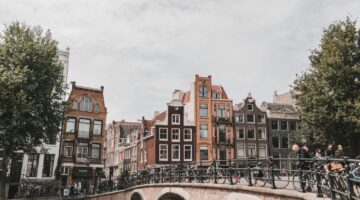
Amsterdam’s Inner City comprises the historic center within the Singelgracht, including the Grachtengordel-Zuid, Grachtengordel-West, Jordaan, Nieuwmarkt/Lastage, Weesperbuurt/Plantage, and both Burgwallen neighborhoods. This UNESCO World Heritage Site is characterized by 17th-century canal-front buildings, with 80% of the structures designated as historic landmarks, and a population density of approximately 8,500 residents per square kilometer.
Bid premiums by sub-region
The overbid percentages in the City Center vary significantly by location and property type. Grachtengordel-Zuid shows an average overbid of 7.8%, while Weesperbuurt/Plantage has the highest rate at 9.5%. Jordaan follows with 9.1%, Nieuwmarkt/Lastage with 8.5%, and Burgwallen-Nieuwe Zijde with 8.1%. Homes with an energy label of B or higher generate 15–20% more overbidding than properties with a label of D or lower.
The City Center in Numbers: Market Data by Subarea
Southern Canal District: Premium segment
- Number of housing units: 184 (152 apartments, 32 single-family homes)
- Average transaction price: €1,203,430
- Price per square meter: €8,863
- Living area: 134.5 m² on average, 4 rooms, 2.3 bedrooms
- Duration of sale: 74 days, 7.8% overbid
Jordaan: Highest price per square meter
- Number of housing units: 585 (533 apartments, 52 single-family homes)
- Average transaction price: €672,993
- Price per square meter: €9,595 (the highest in the city center)
- Living area: 75.2 m² on average, 3.1 rooms, 1.8 bedrooms
- Sale duration: 56 days, 9.1% overbid
Weesperbuurt/Plantage: Fastest-selling
- Number of housing units: 212 (206 apartments, 6 single-family homes)
- Average transaction price: €800,427
- Price per square meter: €8,898
- Living area: 92.9 m² on average, 3.2 rooms, 2 bedrooms
- Duration of sale: 48 days, 9.5% overbid
Step-by-Step Guide: Buying a Home in Downtown (7 Steps)
- Determine your budget, including homeowners’ association fees: In addition to the purchase price, factor in a monthly homeowners’ association fee of €200–€500 and €15,000–€40,000 for sustainability upgrades
- Choose your priority neighborhood: the Canal District for space, the Jordaan for atmosphere, the Weesperbuurt for convenience
- Check listed status and restrictions: 80% are listed buildings with renovation restrictions
- Arrange a specialized inspection: Experts in historic buildings specializing in foundations and structural engineering
- Calculate total housing costs: Mortgage + Homeowners' Association fees + parking permit (€535/year) + energy costs
- Total financing, including a renovation reserve: Banks will finance up to 80% for energy labels F and G
- Make a strategic offer with conditions: Structural inspection and homeowners' association finances must always be subject to these conditions
Schools and family services
Primary schools in the neighborhood are limited to three main options: De Weteringschool (Grachtengordel), Openbare Basisschool De Kroon (Jordaan), and Montessorischool Nieuwmarkt. Childcare centers have waiting lists of 6–12 months; be sure to reserve a spot during pregnancy. Playgrounds are located at Nieuwmarkt, Rembrandtplein, and Westerpark (on the outskirts). Secondary schools: Montessori Lyceum Amsterdam and Het 4e Gymnasium are both within a 15-minute bike ride.
Energy labels and sustainability measures for historic buildings
Current Status of Energy Labels
- Label A/B: 5% of homes
- Label C: 15% of homes
- Label D/E: 60% of homes
- Label F/G: 20% of homes
Listed status limits sustainability measures to interior insulation, high-efficiency boilers, and heat pumps. Double-pane windows on the street side are often not permitted by the Amsterdam Monument Commission. Feasible measures: cavity wall insulation (€8,000–€12,000), floor insulation (€5,000–€8,000), hybrid heat pump (€12,000–€18,000).
Safety and Quality of Life by Zip Code Area
The Amsterdam City Center Safety Index scores 6.2/10 according to the Amsterdam-Amstelland Police (2025). Property crimes are concentrated around Damrak (250 incidents/year), Nieuwmarkt (120 incidents/year), and the Red Light District (400 incidents/year). Quiet zones: Grachtengordel-Zuid (40 incidents/year), Weesperbuurt (65 incidents/year). Bicycle theft remains the main problem, with 1,200 reports per year.
Summary of pros and cons
Benefits
✓ Central Station is a 3–8-minute walk away
✓ Schiphol Airport is 18–22 minutes away by train
✓ The Rijksmuseum and Van Gogh Museum are a 10-minute bike ride away
✓ Value retention thanks to its historic landmark status and prime location
✓ Over 200 restaurants and 50 cafés within 500 meters
Disadvantages
✗ Parking permit: €535/year + 18–24-month waiting list
✗ Tourist traffic: 18 million visitors per year
✗ Homeowners’ association fees: €200–€500 monthly
✗ Energy costs: 40–60% higher due to poor insulation
✗ Limited local amenities (supermarkets, doctors)
Frequently Asked Questions About Downtown Amsterdam (FAQ)
How much does parking cost in the city center?
A parking permit costs €535 per year. The waiting list is 18–24 months. Daily parking: €7.50/hour, maximum €37.50/day.
Are there structural risks associated with canal-side properties?
Yes. Foundation problems occur in 30% of properties built before 1750. Inspection costs: €800–€1,200 by specialized experts.
What kind of homeowners' association fees should I expect?
€200–€500 per month, depending on the size of the property. Additional reserves for facade maintenance (€15,000–€40,000) are common.
Are there any new-build properties available in the city center?
New-build properties are rare due to the area’s historic preservation status. Occasional projects sell within six weeks at a 20–30% premium.
How do mortgages work for historic buildings?
Banks provide financing for up to 80% of the property value for energy efficiency labels F or G. For label C or better, up to 100% financing is possible. A renovation reserve is required.
What are the maintenance costs?
Regular maintenance: €3,000–€5,000 per year. Facade restoration: €25,000–€60,000 per building. Foundation repair: €40,000–€80,000.
Which neighborhoods have a similar vibe?
De Pijp (30% cheaper), Oud-Zuid (similar prices, quieter), Amsterdam-Oost (25% cheaper, trendier).
How long does the sales process take on average?
15–30 days for well-maintained properties. Properties requiring renovation: 45–75 days. Location and energy rating determine the timeline.